
What Are You Optimizing For?
A meditation on human exceptionalism

Perfect your workout and boost your mood
This productivity life hack will change your life!
Burn belly fat with this 3-minute exercise
These 5 healthy habits will unlock your best life
Steal the secret to billionaires’ success
This new superfood will heal your gut biome
50 easy ways to be a fantastic parent
Strengthen your happiness muscle now!
These 7 things will help you like yourself more
I pulled these headlines from the internet, but they are everywhere, the soundtrack to our lives: in news, social media, advertisements, emails, school libraries, gyms, and grocery stores.
Of course they all make perfect sense - seriously, who doesn’t want a healthy gut? And being a fantastic parent? Yes, please.
Yet, with the pressure and immediacy of these messages, they have gone from being good ideas to being demands; from being common to feeling like common sense. They’re easy to take for granted because, after all, don’t they just boil down to our inalienable human rights to life, liberty, and the pursuit of happiness? Don’t they boil down to, “I want to do and be better?”
Unfortunately not, because this is something different. This is the Optimization Mindset.
Optimize /ŏp′tə-mīz″/: Make as fully perfect, functional, efficient, or effective as possible.
Optimization is an engineering concept, the imperative to perfect input-output functions to maximize desired outcomes (e.g., profit) and minimize undesired ones (e.g., time spent). When applied to humans, optimization tells us to be efficient and productive, more, better, and faster - forever. Success is a perpetual upgrade and the Good Life is a set of quantifiable metrics, ready to be entered into a spreadsheet. In other words, according to the optimization mindset, what makes us valuable humans can be described in an algorithm.
Optimization pushes us to become preoccupied with self-improvement: bio-hacking, the explosion of cosmetic GLP-1s, and looksmaxxers “bonesmashing” their faces to shape their cheekbones; but it’s also the avalanche of self-help books, the feelings of failure if you’re not protein loading and eating all organic food, and the parenting influencer marketing their expensive workshop to teach you how to become the good parent you always wanted to be.
We have to ask ourselves, what are we optimizing for? Because optimization is also a value proposition - offering a benefit and a way to achieve our goals. What benefit? The promise of control - control our minds, relationships, bodies, souls, and live longer (maybe forever!), and produce, produce, produce.
Of course, craving control always masks fear. Caught in the optimization mindset, we become vigilant for threat and obsessed with fear of failure - failing to achieve, to be good enough in body and mind, to just be good.
We treat ourselves and our lives like problems to be solved. Does this sound like a human, like a complex living being? Or does it sound like something else?
A machine.
An algorithm.
A mechanism.
Our values are becoming machine values, not human ones:
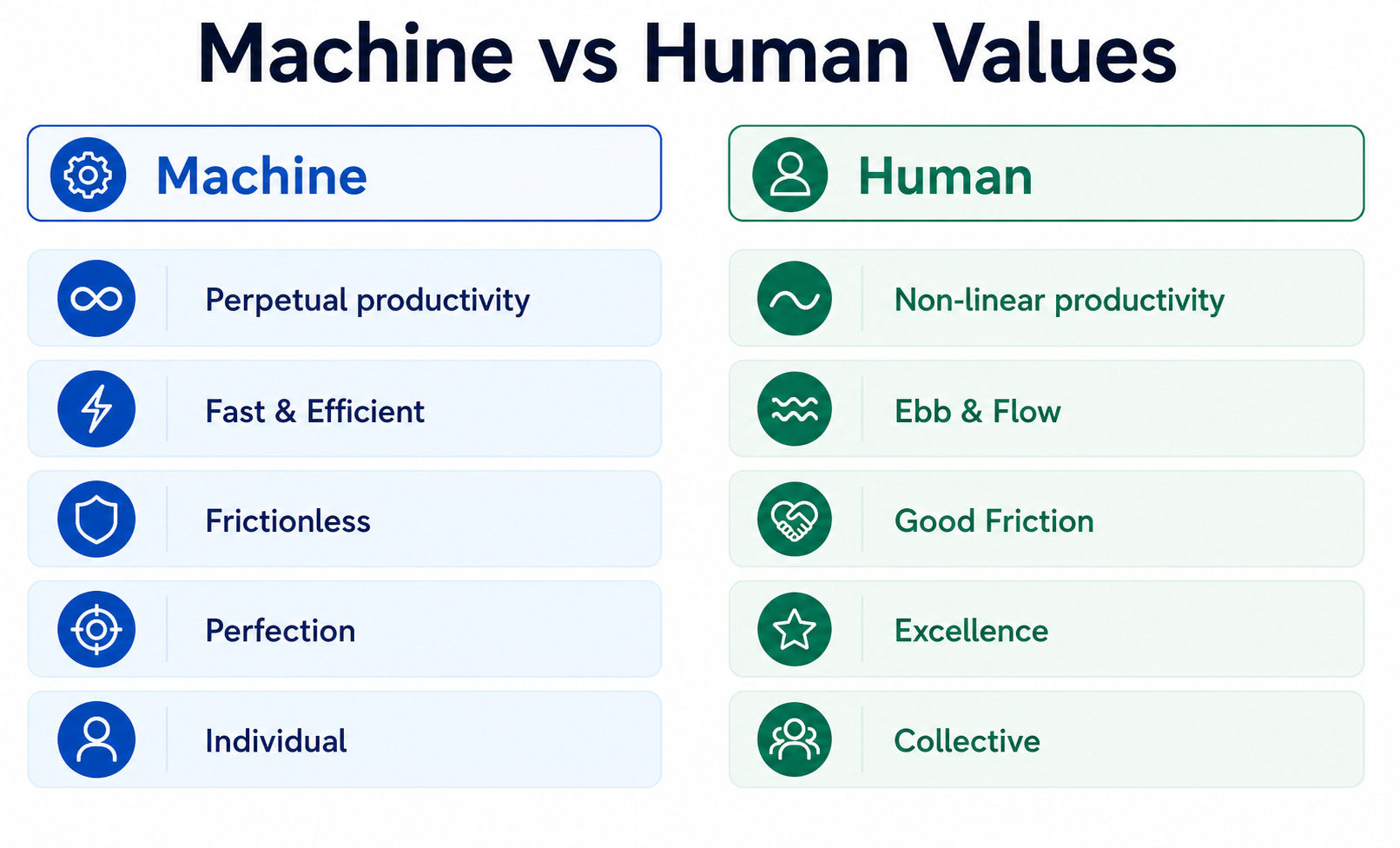
Trying to be better is great. And, oh yes, it’s the American way. But relentless better, productive and frictionless! is not the foundation for human wellbeing, thriving, or health. It just teaches us that we are broken machine that needs fixing.
When we humans live a good life, it’s because we’re aligning our choices and actions towards what matters to us, what we value, what makes life worth living.
No machine can do that - now or ever.
Right now, in this age of AI, we need more human exceptionalism than ever - the belief that technology will never be able to surpass what makes us irreducibly human.
The minute we let go of the need to be more, better, forever, we start to remember what it feels like to feel good in the world. Not because we’re chasing something, but because we’re aligned with something that is good, beautiful, or true. This alignment expresses itself in intuition, insight, creativity, connection, grace, awe, forgiveness, add your own adjectives. ALL THE GOOD THINGS.
This is (among) what makes humans great, exceptional. Right now, in this age of AI, we need more human exceptionalism than ever - the belief that technology will never be able to surpass what makes us irreducibly human.
Become more free, and even more in control by remembering: we don’t have to see ourselves in machines, or see machines in ourselves.
We need more essays like this! Thanks for putting my fears and frustrations into words:)